
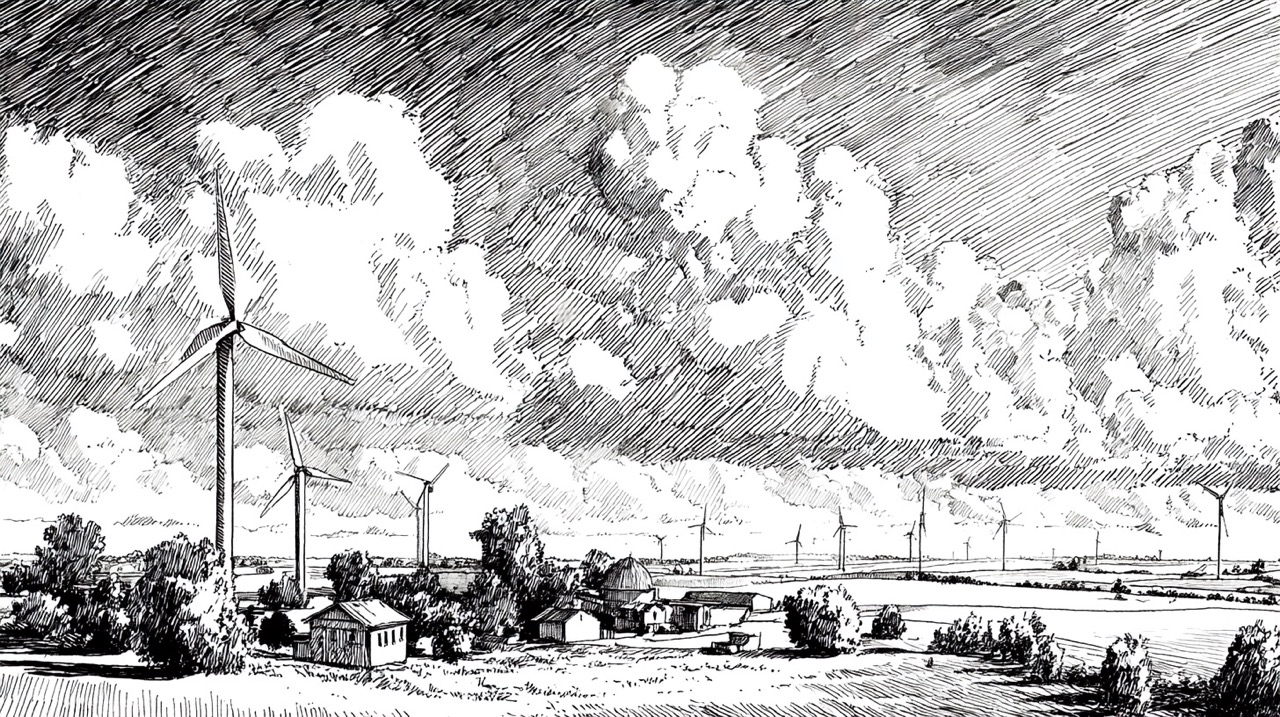
Sometimes research has to be carried out under considerable time pressure. In this case, a concise research report on public discussions surrounding several planned wind farms had to be produced at short notice. As the projects were already known to us from various press articles, our researcher was able to prepare the report quickly.
We also needed to check whether another project was planned in a neighbouring area. The researcher found no indication of this in either press coverage or municipal documents. Perplexity and ChatGPT were then asked about possible additional projects and were both given a geographically precise description of the area in question. Both initially responded with the projects that were already known. When asked explicitly whether any other projects were known, Perplexity corrected its answer and confirmed that no additional development was known. ChatGPT, by contrast, incorrectly placed a project located further north within the study area and also made inaccurate statements about the location of neighbouring municipalities.
ChatGPT was subsequently used to improve the wording of the report. This worked well: the text was shortened by 20% by removing redundancies. Long and complex sentences were also broken up, while clearer paragraph structure helped make the text more precise.
Our conclusion: AI models can help validate research findings. In this case, they supported the assumption that no additional project existed, albeit only indirectly, by returning the already known projects. However, their answers should never be accepted without verification.
Our recommendation for this type of research: LLMs can be useful for checking the information landscape again when manual research has produced no results. Careful verification remains essential, however, otherwise supposed knowledge can quickly become a source of error. We repeatedly find that models appear more inclined to provide information that seems broadly relevant but is ultimately incorrect than to state clearly that there is not enough information available to answer the question.
By Maria Kleiner